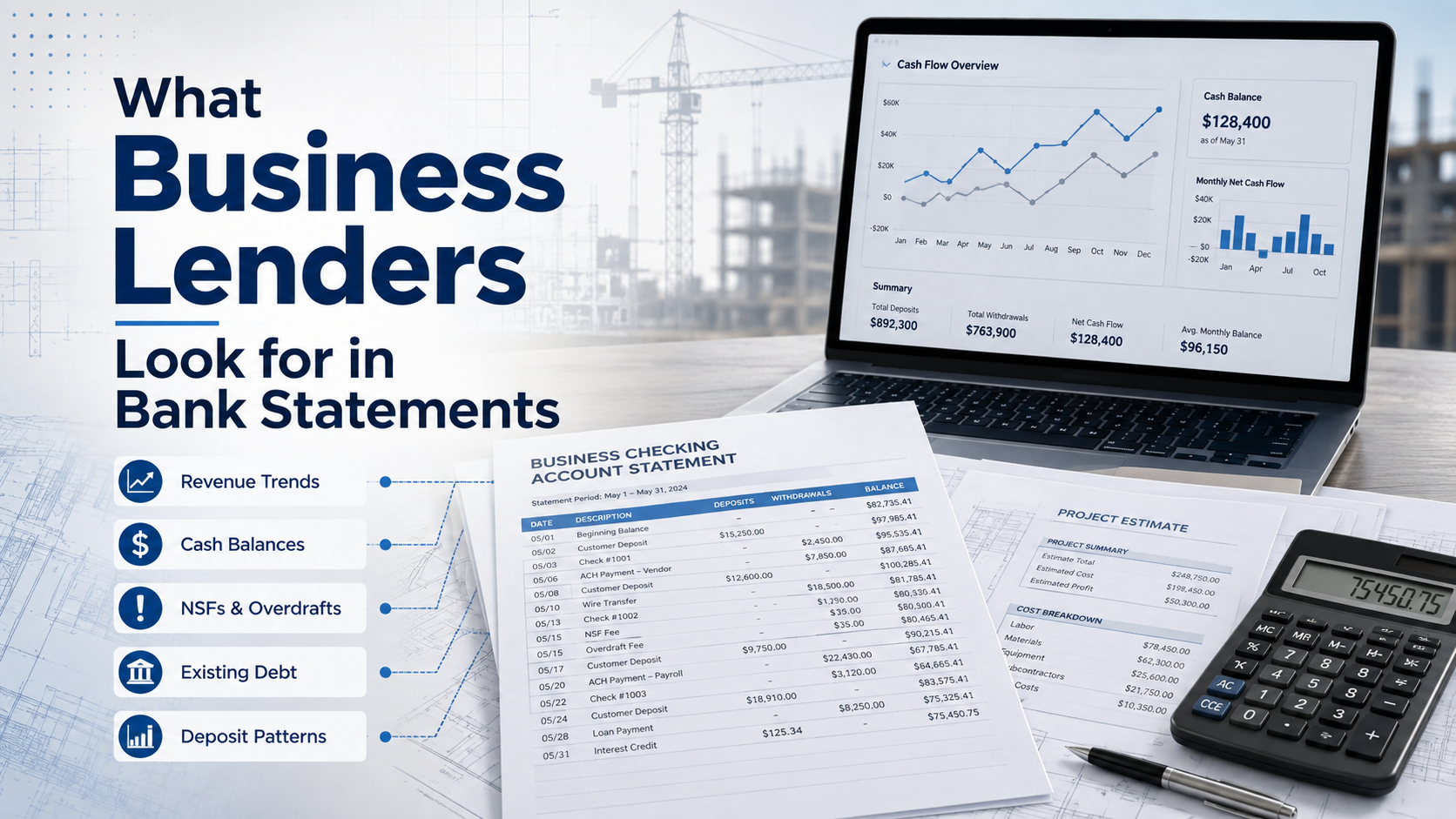
A lender asks for your business bank statements.
What exactly are they looking for?
The short answer is that business bank statements can help a lender understand how money actually moves through your company. Depending on the financing product and provider, an underwriter may review operating deposits, revenue trends, available cash, overdrafts, existing financing payments, unusual transactions and whether the business appears capable of supporting another financial obligation.
There is no single bank-statement formula that determines whether a business qualifies for funding.
One lender may put significant weight on recent cash flow. Another may require deeper financial statements, tax returns or collateral information. An equipment lender, bank, line-of-credit provider and working-capital provider can look at the same business differently.
For contractors and home-service companies, this matters even more because cash flow rarely arrives in a perfectly even pattern. Materials may need to be purchased before a project starts. Payroll continues while an invoice is outstanding. Progress payments can be separated by weeks. Retainage may remain unpaid after the underlying work is complete.
A profitable contractor can therefore show substantial revenue and signed work while still experiencing significant changes in operating cash from one week to the next.
Understanding what an underwriter may see in your statements can help you prepare a cleaner, more complete funding request and better understand the questions that may follow.
Contractor Capital is a funding marketplace, not a direct lender. Independent funding providers establish their own underwriting standards and make all approval, pricing and funding decisions.
Quick Answer: What Do Business Lenders Look for in Bank Statements?
Depending on the lender and financing product, a business bank-statement review may consider:
- Operating deposits
- Monthly revenue patterns
- Revenue growth or decline
- Average or typical cash balances
- Ending balances
- Low-balance or negative-balance activity
- Overdrafts and non-sufficient-funds transactions
- Existing business financing payments
- Major recurring expenses
- Large or unusual deposits
- Transfers between accounts
- Revenue or customer concentration when identifiable
- Seasonality
- Cash-flow volatility
- Whether personal and business activity are clearly separated
- Whether the business appears able to support the proposed payment
Not every lender measures these items in the same way, and not every item will matter equally for every financing product.
The purpose of the review is generally broader than finding one good or bad transaction.
The lender is trying to understand the financial behavior of the business.
Why Do Business Lenders Ask for Bank Statements?
Different financial records answer different underwriting questions.
A profit-and-loss statement shows accounting revenue and expenses over a period.
A balance sheet shows assets, liabilities and equity at a point in time.
Tax returns provide historical financial and tax information.
Credit reports can provide information about borrowing history and existing credit obligations.
Bank-account information provides another perspective:
What is actually happening with the company's cash?
Cash-flow data can provide lenders with a relatively current view of business inflows and available cash reserves, which is one reason it has become an important underwriting input across different parts of the small-business credit market.
The way those statements are evaluated can also vary depending on the business funding options being considered. A bank term loan, line of credit, equipment financing request and working-capital product may each place different weight on recent cash flow, historical financials, collateral, credit and other parts of the borrower profile.
A company can be profitable on its income statement while still being short on cash.
For example, a commercial contractor might complete substantial billable work during March but not collect the corresponding receivable until April or May.
The income exists.
The cash may not exist yet.
A lender evaluating a new payment obligation needs to understand that difference.
Bank Statements and Bank Transaction Data Are Not Always the Same Thing
This distinction is worth understanding.
Some providers may ask you to upload PDF bank statements.
Others may ask you to connect a business bank account securely or provide recent transaction history.
Some may use a combination.
A monthly PDF statement provides information about deposits, withdrawals, opening and closing balances and other activity during the statement period.
Transaction-level data can provide a more detailed view of how cash moved through the account from day to day.
That means some underwriting metrics commonly described as "bank-statement underwriting" may actually be calculated using detailed transaction data rather than information printed directly on the monthly statement.
For example, a provider may be able to analyze:
- Daily balance patterns
- Frequency of low balances
- Deposit timing
- Recurring withdrawals
- Revenue trends
- Changes in cash reserves
The underwriting method depends on the provider.
The important point for the borrower is that lenders may be evaluating the behavior behind the account, not simply the balance appearing on the final page of a statement.
1. Operating Deposits
One of the first questions an underwriter may try to answer is:
How much money is actually coming into this business from normal operations?
This can be more complicated than looking at the total-deposit figure.
A business account may receive:
- Customer payments
- Progress payments
- Credit-card processor settlements
- ACH payments
- Checks
- Transfers from another company account
- Owner contributions
- Loan proceeds
- Insurance proceeds
- Tax refunds
- Asset-sale proceeds
Those deposits do not all represent operating revenue.
Imagine a contractor whose statement shows $175,000 in total deposits for the month.
If $45,000 came from moving money from a company savings account into operating checking, an underwriter may distinguish that transfer from new customer revenue.
The money increased the checking-account balance.
It did not create another $45,000 of sales.
This is why the deposit total printed on a bank statement should not automatically be treated as the revenue figure an underwriter will use.
2. Revenue Consistency
The amount of revenue matters.
The pattern can matter too.
Consider two contractors that each generated approximately $600,000 of operating deposits over six months.
One receives roughly $95,000 to $105,000 each month.
The other receives:
$165,000
$55,000
$145,000
$50,000
$140,000
$45,000
The total may be similar, but the cash-flow profiles are different.
That does not mean the second company is automatically weaker.
The explanation may simply be the type of work it performs and how customers pay.
A residential service company may process many smaller transactions each week.
A commercial subcontractor could receive several large progress payments tied to billing milestones.
A remodeling company may collect a deposit at signing, another payment when materials are delivered and a balance near completion.
The underwriter may therefore consider whether the deposit pattern is reasonable for the type of company being reviewed.
The objective is not necessarily perfectly even revenue.
The objective is understanding whether cash flow appears legitimate, understandable and sufficient for the proposed financing.
3. Revenue Trends
An underwriter may also compare one month with another.
Is revenue:
Increasing?
Stable?
Declining gradually?
Dropping sharply?
Recovering?
A single weaker month can mean many things.
Perhaps several customer payments crossed into the following statement period.
Perhaps the business completed a major project the previous month.
Perhaps poor weather delayed installations.
Perhaps revenue is actually declining.
The numbers can identify the change.
They do not always explain it.
This is where additional documentation or a concise explanation can become useful.
If a material change has a legitimate business explanation, being prepared to document it can help the underwriter understand what actually happened.
It does not guarantee that the lender will disregard the weaker period.
It gives the lender better information with which to evaluate it.
4. Cash Balances and Liquidity
Revenue alone does not tell a lender how much financial breathing room the company has.
A business can produce significant monthly sales while maintaining very little cash.
For that reason, some providers may evaluate the level of liquidity normally maintained in the account.
Consider two contractors generating $150,000 per month.
One typically maintains $35,000 to $50,000 of available operating cash.
The other regularly drops below $2,000 while waiting for the next customer payment.
Both may be legitimate businesses with similar revenue.
Their ability to absorb a disruption may be very different.
That disruption could be:
- A customer paying two weeks late
- An unexpected equipment repair
- A supplier requiring an earlier payment
- Additional payroll
- A project delay
- A disputed invoice
- Another financing payment
Available cash is not the entire underwriting decision.
It can, however, help a lender understand how much cushion exists when actual business activity does not follow the expected schedule.
5. Low Balances, Negative Days, Overdrafts and NSFs
Cash pressure can also appear through overdrafts and non-sufficient-funds activity.
Depending on the lender, underwriting may consider:
- Whether overdrafts occurred
- How recently they occurred
- How frequently they occurred
- Whether attempted payments were returned
- Whether negative balances were isolated or recurring
- Whether recent account behavior is improving or deteriorating
There is no responsible industry-wide rule such as "one NSF is acceptable" or "three NSFs cause a decline."
Provider standards vary.
An isolated overdraft caused by a customer payment arriving one day later than expected is different from an account that repeatedly lacks sufficient cash to meet routine obligations.
Both situations may produce an overdraft.
The pattern and context are different.
Repeated cash shortfalls may receive more attention because the lender is considering whether adding another payment could place further pressure on the company.
6. Existing Loans and Financing Payments
Bank activity can help reveal what the company is already obligated to pay.
Recurring withdrawals could represent:
- Business term loans
- Equipment financing
- Vehicle financing
- Working-capital products
- Revenue-based financing
- Tax-payment arrangements
- Other recurring financial obligations
Existing financing is not automatically a problem.
Healthy businesses use debt and credit routinely.
The underwriting question is usually more practical:
How much of the company's existing cash flow is already committed?
Suppose two contractors each generate $125,000 per month.
One has modest equipment and vehicle payments.
The other is already making several substantial daily or weekly financing payments.
The topline revenue looks similar.
The amount of cash available to support another obligation may not be.
This is one reason borrowers should disclose existing financing accurately.
If the obligation appears in bank transactions, the provider may identify it during review anyway.
7. Major Recurring Cash Outflows
A bank statement does not only show money coming in.
It also shows money leaving.
Depending on the underwriting process, recurring cash outflows may help the lender understand the company's operating burden.
These can include:
- Payroll
- Supplier payments
- Rent
- Insurance
- Taxes
- Vehicle payments
- Equipment obligations
- Debt payments
- Regular transfers
- Other operating expenses
The lender may not be attempting to construct a complete accounting system from the bank statement.
Instead, these transactions can help provide context around how quickly revenue is being consumed.
A contractor producing substantial revenue but carrying very high fixed obligations can have less financial flexibility than topline sales suggest.
8. Transfers Between Accounts
Many established contractors use multiple accounts.
A company might maintain:
- An operating checking account
- A payroll account
- A tax reserve
- A savings account
- An account for a separate division
- Accounts at more than one bank
That is normal.
But it creates an underwriting issue.
If $50,000 is transferred from company savings to company checking, it should not automatically become another $50,000 of business revenue.
If that $50,000 is later moved into another company account, it should not become revenue again.
An underwriter may therefore need to identify internal transfers so that the same money is not counted multiple times.
This is also why additional statements may be requested when meaningful business activity flows through several accounts.
The lender may need a complete enough picture to understand what is operating revenue, what is a transfer and where major expenses are actually being paid.
9. Large or Unusual Deposits
A large deposit can improve the account balance.
It does not automatically demonstrate recurring business revenue.
An underwriter may want to understand whether a significant deposit represents:
- Payment from a customer
- A project draw
- Loan proceeds
- An owner contribution
- A transfer
- Insurance proceeds
- Sale of equipment or another asset
- A refund
- Another one-time event
Suppose a contractor receives a $100,000 deposit.
If that is payment on a completed commercial project, it can be relevant operating activity.
If it is proceeds from another new loan, the financial interpretation is completely different.
The amount is identical.
The source matters.
10. Customer or Deposit Concentration
Some businesses rely heavily on a small number of customers.
That can be common in commercial construction.
A subcontractor might generate several million dollars of annual revenue while receiving a large percentage of that revenue from two general contractors.
That does not make the business unsuccessful.
It can create concentration risk.
If a major customer delays payment, reduces work or ends the relationship, the effect on cash flow can be much larger than it would be for a company with hundreds of unrelated customers.
Bank information may sometimes reveal repeated large payments from identifiable sources.
More detailed concentration analysis, however, may require additional records such as an accounts-receivable aging, customer list, contracts or financial statements.
The bank statement can raise the question.
Other documents may provide the complete answer.
11. Cash-Flow Volatility
Contractor cash flow can move sharply even when the underlying company is healthy.
Imagine an electrical contractor mobilizing three projects at approximately the same time.
During the first several weeks, the company may need to fund:
- Electrical gear deposits
- Wire and materials
- Payroll
- Equipment rentals
- Insurance
- Permits
- Subcontractors
- Mobilization costs
The corresponding project payments may arrive later through progress billing.
The business could have profitable work under contract and still experience a substantial temporary reduction in available cash.
These timing gaps are one reason contractors may explore working capital when expenses need to be covered before corresponding project revenue is collected.
An underwriter may therefore look at whether account volatility appears connected to the normal operating cycle or whether the company is struggling to meet routine obligations.
That distinction is especially important in project-based businesses.
12. Seasonality
Some contractors naturally produce more revenue during particular periods.
Examples can include businesses heavily exposed to:
- Roofing
- Landscaping
- Pool construction
- Heating or cooling demand
- Exterior work
- Storm restoration
- Regional weather patterns
Seasonality is not automatically negative.
The lender may simply need enough history to distinguish normal seasonal movement from an actual deterioration in the business.
A lower-revenue month in January can mean something very different for a landscaping company than it does for a business whose normal revenue is consistent throughout the year.
The relevant question is not:
Did revenue change?
It is:
Why did it change, and is the pattern consistent with the way this business normally operates?
13. Separation of Business and Personal Activity
A dedicated business account can make underwriting easier to understand.
When substantial personal transactions are mixed into the operating account, it can become more difficult to distinguish:
- Business revenue
- Business expenses
- Owner draws
- Personal expenses
- Transfers
- Actual operating cash flow
This does not mean an occasional personal transaction automatically prevents financing.
The larger issue is clarity.
Cleaner separation between business and personal finances gives the underwriter a more usable view of what the company itself is doing.
It can also make the business owner's own financial reporting easier to maintain.
14. Whether the Business Can Support the Proposed Payment
Ultimately, much of the analysis comes back to one question:
Can this business reasonably support another financial obligation?
That is not the same question as:
Does this business generate significant revenue?
Imagine a company generating $200,000 every month.
That sounds strong.
But if nearly all of that cash is already required for payroll, materials, rent, taxes, equipment and existing debt, there may be limited room for another payment.
Another company generating less revenue might maintain stronger available liquidity and fewer existing obligations.
A lender may therefore consider the relationship among:
- Revenue
- Cash balances
- Cash-flow patterns
- Existing obligations
- Requested amount
- Proposed payment
- Repayment frequency
- Other elements of the borrower profile
The amount a business wants to borrow is not necessarily the amount a provider determines that its cash flow can reasonably support.
This is one reason two lenders reviewing the same company can reach different conclusions.
Bank Statements Do Not Tell the Whole Story
Bank statements are useful because they show actual cash movement.
They are also incomplete.
A bank statement does not automatically tell a lender:
- Whether a particular project is profitable
- How much money customers currently owe the company
- How much the company owes suppliers
- Whether an invoice is collectible
- What signed work is scheduled
- When a contract allows the company to bill
- Whether retainage applies
- What gross margins the company earns
- Whether a recent expense was unusual
- What equipment the company owns
- Whether an upcoming project requires substantial mobilization
- What the owner's complete credit profile looks like
That is why underwriting can extend beyond bank statements.
For example, a business with substantial accounts receivable may have significant revenue already earned but not yet collected. In those situations, a lender may need additional information to understand the quality, timing and collectability of those receivables rather than relying only on the cash currently visible in the operating account.
Depending on the product and lender, additional documents may include:
- Profit-and-loss statements
- Balance sheets
- Tax returns
- Accounts-receivable aging reports
- Accounts-payable aging reports
- Contracts
- Purchase orders
- Invoices
- Project documentation
- Equipment quotes
- Business formation records
- Existing debt information
- Owner identification
- Personal financial information
- Credit authorization
For example, certain SBA working-capital facilities specifically require borrowers to be capable of producing timely financial statements and accounts-receivable and accounts-payable aging information.
The broader lesson is important:
A funding request is evaluated as a borrower profile, not as a single bank-statement score.
Why Contractor Bank Statements Can Require More Context
Project-based businesses can look unusual when viewed only through monthly transaction totals.
Consider a commercial flooring contractor with a $500,000 awarded project.
The company may need to place substantial material orders before installation begins.
It may then need to cover:
- Labor
- Freight
- Equipment
- Insurance
- Project supervision
- Subcontractors
- General overhead
The customer may not release the corresponding payment until a billing milestone is reached and approved.
The contractor could therefore have:
Strong revenue
Profitable contracted work
Experienced crews
A healthy backlog
And a temporary cash shortage
at the same time.
Now compare that company with a residential plumbing operation that receives dozens of card and ACH payments every week.
The plumbing company may show hundreds of relatively small deposits.
The flooring contractor may show fewer but substantially larger payments.
Neither pattern is automatically better.
They represent different businesses.
A sound funding review should consider the type of company, how it bills, how long collections take and what costs must be carried before revenue is collected.
What Makes a Business Bank-Statement Profile Stronger?
There is no legitimate trick for manufacturing a strong bank statement.
A stronger profile generally comes from the underlying financial health and organization of the business.
Characteristics that may help provide a clearer underwriting picture include:
- Consistent legitimate operating deposits
- Adequate available liquidity
- Manageable existing obligations
- Limited recurring overdraft activity
- Clear separation between business and personal finances
- Accurate disclosure of current financing
- Financial records that reasonably align with operating activity
- Understandable explanations for unusual transactions
- Sufficient cash flow for the proposed payment
None of these items guarantees funding.
A weakness in one area does not automatically mean financing is unavailable either.
Different providers evaluate risk differently and may place greater weight on different parts of the borrower profile.
What Should You Do Before Sending Bank Statements?
Do not attempt to make the statements look better.
Review them so you understand what the lender is going to see.
Never edit transactions, change balances, remove pages or hide obligations.
Instead, look for legitimate activity that may need explanation.
Examples include:
- A sudden drop in deposits
- A very large one-time deposit
- An unusual transfer
- Several overdrafts
- Recent loan proceeds
- A major tax payment
- Revenue split among several accounts
- A customer payment received immediately after the statement period closed
- An obligation that was recently paid off but still appears in earlier statements
If something has a legitimate explanation, be prepared to explain it.
Supporting information can sometimes help establish the context.
Suppose a contractor's statement closes on April 30.
A $90,000 approved project payment arrives on May 2.
The April statement will not show that payment.
Recent transaction history, the following statement, an invoice or other requested documentation may help explain what happened.
An explanation does not replace underwriting.
It helps make the information more complete.
Should You Send Every Business Bank Account?
Not necessarily.
But the lender needs an accurate view of the business being underwritten.
If nearly all operating activity flows through one business checking account, that may be the principal account requested.
If substantial revenue enters another account, payroll runs from a separate account or major obligations are paid elsewhere, additional statements may be needed.
The safest approach is not to decide for the lender which accounts matter.
Disclose the way the business operates and provide the accounts the provider requests.
How Many Months of Bank Statements Do Business Lenders Request?
There is no universal requirement.
The period varies by provider, product, requested amount, business history and complexity.
Some financing providers may begin with several recent months of business bank statements. Other lenders may require a longer period plus tax returns, financial statements and additional documentation.
Current lender requirements illustrate that variation. Some online providers allow applicants to connect a bank account instead of manually uploading statements, while other products request several months or considerably more financial history.
Contractor Capital commonly begins its review process by requesting the four most recent business bank statements along with the application, but an independent provider may request additional months or other financial documentation during underwriting.
The key distinction is that four months is not an industry rule.
It is part of an initial package that can help begin the review.
Why Might a Lender Ask for Current-Month Transactions?
The most recent completed statement can already be several weeks old.
A lender may therefore request current-month activity, transaction history or another form of bank verification before completing underwriting.
That information may help answer questions such as:
- Has revenue continued?
- Has the account balance materially changed?
- Have recent overdrafts occurred?
- Has another financing obligation appeared?
- Has a major customer payment arrived?
- Has the company taken additional financing?
- Has substantial cash left the account?
The terminology varies.
Some people call this a month-to-date transaction report.
Others may simply request current transactions or use a secure bank connection.
The purpose is generally to see what has happened since the latest completed statement.
Why Doesn't Strong Personal Credit Replace Bank Statements?
Personal credit and business cash flow measure different things.
A strong personal credit profile may support the overall borrower profile.
It does not tell the lender how much revenue the business is currently generating or how much cash is available to service another obligation.
Likewise, strong current business cash flow does not automatically replace credit requirements for products that consider personal or business credit.
Many lenders evaluate several sources of information together.
That can include:
- Credit history
- Business revenue
- Cash flow
- Time in business
- Existing debt
- Financial statements
- Owner information
- Requested amount
- Funding purpose
This is why a business owner with excellent credit may still be asked for bank statements.
Do Signed Contracts Replace the Need for Bank Statements?
Usually not.
A contract and a bank statement answer different underwriting questions.
The contract can provide information about future work.
The bank statement provides information about how the existing business is operating today.
A lender reviewing an awarded contract may still want to understand:
- Current business revenue
- Available liquidity
- Existing financing
- Project costs
- Customer payment terms
- Billing milestones
- Retainage
- Business operating history
- Whether the company has capacity to execute the project
- Whether repayment can be supported if payment is delayed
Contracts can be valuable supporting documentation.
They do not automatically replace evidence of current financial capacity.
Can Strong Bank Statements Overcome Weaknesses Elsewhere?
Possibly, depending on the provider and the weakness involved, but there is no universal answer.
Underwriting is usually a combination of factors rather than a single pass-or-fail test.
One provider might place substantial weight on current cash flow.
Another may require a minimum credit profile, time in business or collateral regardless of recent bank activity.
A strong operating account can therefore strengthen a funding request without guaranteeing that every other underwriting requirement will be waived.
This is one reason it can be useful to evaluate the complete borrower profile rather than trying to determine eligibility from one number.
Can Weak Bank Statements Be Explained?
Some activity can be explained.
That does not mean it can always be overcome.
There is an important difference.
An isolated event may have a straightforward explanation.
For example:
A customer paid after the statement closed.
A large withdrawal represented a one-time equipment purchase.
An old financing obligation was recently paid off.
Funds were transferred between operating accounts.
A major project caused temporary mobilization costs.
Providing documentation can help an underwriter classify the activity correctly.
But an explanation cannot turn chronic negative cash flow into positive cash flow or eliminate repayment obligations that still exist.
Good underwriting should be based on accurate information, not storytelling designed to make financial weakness disappear.
A Contractor's Bank-Statement Review Checklist
Before submitting a funding request, review your recent business bank activity and answer the same broad questions an underwriter may ask.
Revenue
What are my normal monthly operating deposits?
Are internal transfers included in total deposits?
Is revenue increasing, stable or declining?
Are any months significantly different from the others?
Do I know why?
Liquidity
How much available cash does the business typically maintain?
Does the account repeatedly fall close to zero?
Are overdrafts isolated or recurring?
Could the business handle a customer payment arriving late?
Existing Obligations
What financing payments are currently leaving the account?
Have all existing obligations been disclosed?
Has anything recently been paid off?
How much cash flow is already committed?
Deposits
Can I identify unusually large deposits?
Are major transfers between company accounts easy to explain?
Does a large portion of revenue come from a small number of customers?
Accounts
Does operating activity occur in more than one bank account?
Are business and personal transactions reasonably separated?
Will the lender need statements from additional accounts to understand the business?
Documentation
Are the statements complete?
Are all pages included?
Do the financial statements generally align with actual business activity?
Can unusual transactions be supported if the lender asks about them?
Funding Purpose
What exactly will the new capital fund?
How is that use expected to benefit the business?
What cash flow is expected to support repayment?
When should that cash arrive?
What happens if it arrives later than expected?
These final questions are particularly important.
A lender is not only examining what happened during the previous few months.
The provider is considering what the company's finances may look like after another obligation is added.
How Contractor Capital Helps With the Funding Review Process
Business funding underwriting is not standardized.
A provider focused on cash flow may interpret a company's recent operating activity differently from an equipment-financing provider, invoice-financing company, traditional bank or longer-term lender.
That is one reason understanding more than one potential funding path can be useful. Different providers may place greater weight on different parts of the borrower profile, and a funding structure that works well for one business need may be less appropriate for another.
Businesses deciding where to seek capital may also benefit from understanding how business funding can differ from traditional bank lending, particularly in areas such as underwriting, documentation, repayment structure, speed and overall cost.
Contractor Capital is a contractor-focused funding marketplace, not a direct lender.
We help contractors and home-service businesses explore potential financing categories based on their business profile and funding needs and connect qualified applicants with independent providers.
An initial funding package commonly includes a completed application and the four most recent business bank statements.
As underwriting progresses, a provider may request additional information such as:
- Owner identification and address
- Social Security number or other identifying information
- Additional bank statements
- Profit-and-loss statements
- Balance sheets
- Tax returns
- Accounts-receivable information
- Contracts
- Invoices
- Equipment documentation
- Existing debt information
- Other records relevant to the requested financing
Providing this information does not guarantee approval.
Contractor Capital does not make final credit decisions and does not guarantee approval, funding amounts, pricing, terms or funding timelines.
All underwriting and funding decisions are made by the independent provider.
The Bottom Line
Business bank statements give lenders a recent view of something that annual financial documents cannot show as directly:
how cash is actually moving through the company right now.
For a contractor, that can include customer deposits, progress payments, supplier bills, payroll, equipment costs, transfers, existing financing and substantial changes in available cash throughout the life of a project.
A lender may use that information to understand revenue, liquidity, existing obligations, cash-flow patterns and whether another payment appears supportable.
There is no single deposit amount, bank balance, overdraft count or other universal metric that guarantees approval.
The strongest approach is much simpler:
Maintain accurate business accounts.
Provide complete information.
Disclose existing obligations.
Understand unusual transactions.
Keep supporting financial records current.
And know exactly what the requested capital is intended to accomplish and how the business expects to support repayment.
A bank statement is not simply a document a lender asks for.
It is one of the clearest records of how the business actually operates financially.
Understanding what it shows can help a business owner enter the funding process better prepared.
Understand Your Options Before Choosing Business Funding
If your contracting or home-service business needs capital for materials, payroll, equipment, project costs, receivables or growth, Contractor Capital can help you explore potential funding options through independent providers.
A completed funding request and recent business bank statements can help us begin evaluating which financing paths may be appropriate for your business. Additional financial and owner information may be required as the request moves through underwriting.
Submitting a request does not guarantee approval, rates, terms, timing or a particular funding amount.
Frequently Asked Questions
Do transfers between business accounts count as revenue for a business loan?
Not necessarily. Moving money from one company account to another does not create new business revenue. An underwriter may attempt to separate customer or operating deposits from internal transfers, owner contributions, financing proceeds and other non-operating deposits.
Will one overdraft or NSF cause my business funding application to be declined?
Not automatically. There is no universal lender rule. A provider may consider how recent the event was, whether it was isolated or recurring, how the account recovered and the strength of the overall borrower profile. Repeated cash shortfalls may receive more scrutiny than a single isolated event.
Is the total deposit amount on my bank statement the same as my business revenue?
Not always. Total deposits can include customer revenue, transfers, owner contributions, loan proceeds, refunds and other transactions. A lender may attempt to identify actual operating deposits rather than treating every dollar deposited into the account as sales.
Can a lender see that I already have another business loan?
Recurring ACH withdrawals and other transactions may indicate existing financing. A provider may request information about current lenders, balances and payment obligations. Existing financing should be disclosed accurately during the application process.
Why does a lender need bank statements if my business is profitable?
Profit and available cash are different. A business can report accounting profit while cash is tied up in accounts receivable, materials, inventory or work in progress. Bank activity helps a provider evaluate recent liquidity and actual cash movement.
Why is the lender asking for current-month transactions after I already sent bank statements?
Your most recent completed statement may no longer reflect what is happening today. Current transactions can help a provider identify recent changes in revenue, balances, overdrafts, deposits or financial obligations.
Should I send statements from all of my business bank accounts?
If meaningful operating revenue or expenses flow through multiple accounts, the provider may require more than one account to understand the complete business picture and correctly identify transfers. Provide the accounts the lender or funding provider requests.
Does having a large bank balance improve my chances of getting funded?
Liquidity can be a positive part of the borrower profile, but a large balance does not guarantee approval. The lender may also evaluate the source of the funds, revenue history, existing obligations, credit, business history and other underwriting factors.
Do signed contracts help if my bank statements are weaker?
Contracts may help demonstrate future work, but they do not automatically replace evidence of current financial capacity. A lender may review the contract together with existing revenue, available cash, project costs, payment milestones, current obligations and operating history.
Can strong recent revenue make up for older weak months?
It may help demonstrate improvement, but how much weight recent performance receives depends on the lender and financing product. A provider may request additional months of statements or other financial information to determine whether the improvement appears sustainable.
Does personal credit matter if my business bank statements are strong?
It can. Some financing products place substantial weight on business cash flow, while others also have personal or business credit requirements. Strong bank activity does not automatically eliminate other underwriting criteria.
Can I redact or edit transactions before submitting bank statements?
Do not alter financial documents submitted for underwriting. Providers may require complete statements or independently verified bank information. If a legitimate transaction needs context, explain it accurately rather than modifying the record.